Innovation in Islamic Religious Education Learning Through the Utilization of Educandy Interactive Game Media
Abstract
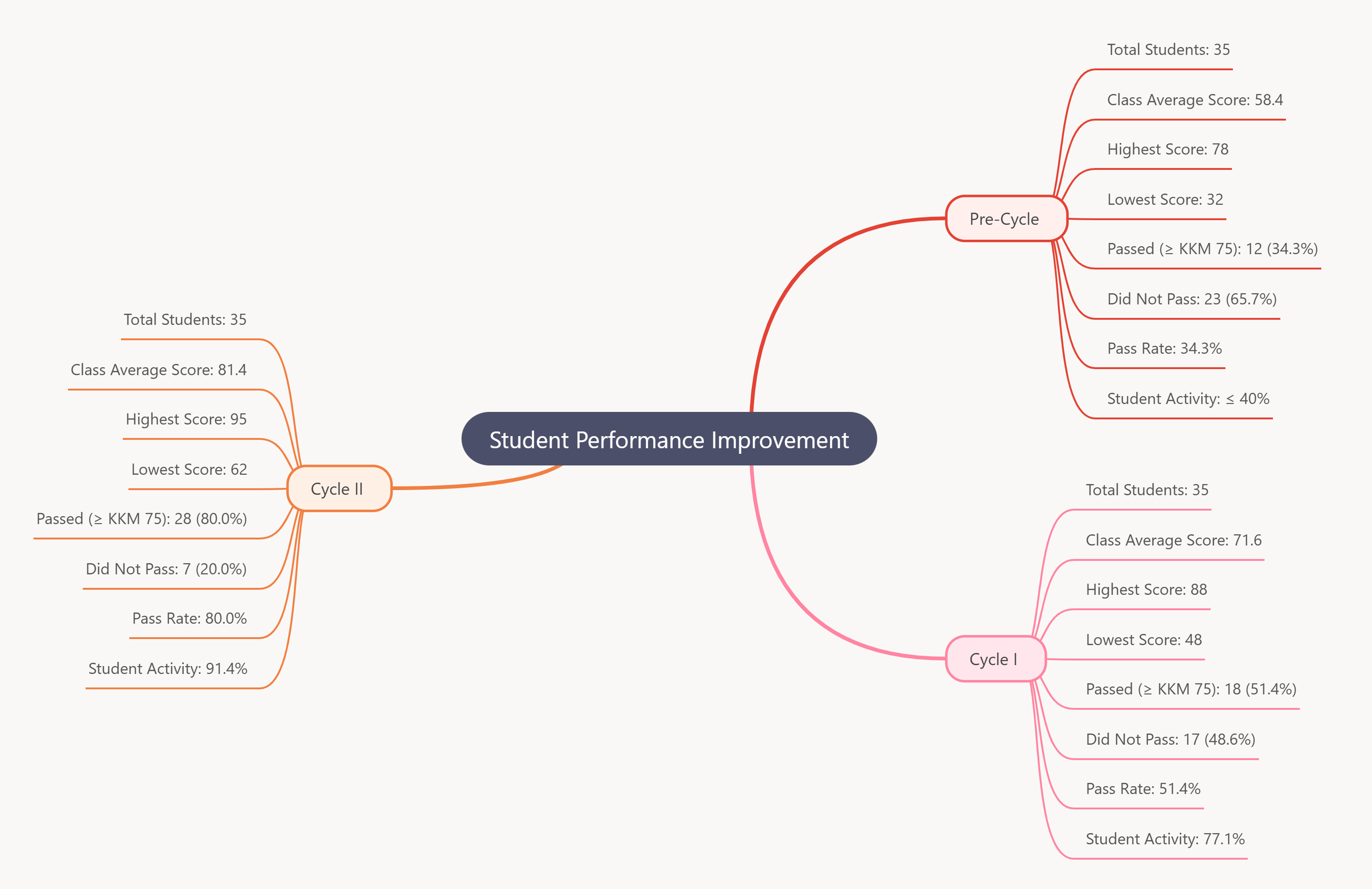
This study aims to improve students’ cognitive learning outcomes in Islamic Religious Education (IRE) through the use of the Educandy interactive game. This study was motivated by low student learning outcomes caused by the dominance of conventional teaching methods that are unengaging and not fully aligned with student characteristics in the digital age. The research method employed was Classroom Action Research (CAR) using the Kemmis and McTaggart model, conducted in two cycles, encompassing the planning, implementation, observation, and reflection stages. The research subjects were 10th-grade students at SMK Al-Hidayah Cirebon during the odd semester of the 2025/2026 academic year. Data collection techniques included cognitive tests, observation of student activities, interviews, and documentation. The research results indicate that the implementation of the Educandy interactive media significantly improved students’ cognitive learning outcomes. This improvement is evidenced by an increase in the class average score from 58.4 (pre-cycle) to 71.6 (Cycle I), and finally to 81.4 in Cycle II. In line with this, the percentage of mastery in traditional learning increased from 34.3% to 51.4% in Cycle I, and reached 80.0% in Cycle II, successfully exceeding the predetermined success indicator (≥ 75). This increase was driven by the media familiarity effect, increased engagement in group learning, and a healthy competitive environment introduced by the leaderboard feature.
Downloads
References
Alwadai, Mesfer. “Islamic Teachers’ Perceptions of Using Gamification in Saudi Arabian Elementary Schools.” Advances in Social Sciences Research Journal, 2022. https://doi.org/10.14738/assrj.68.6935
Creswell, John W, and John D Creswell. Research Design: Qualitative, Quantitative, and Mixed Methods Approaches. SAGE Publications, 2018.
Dalimunthe, Afifah Khairiah, and Icha Sa’ida Zahara. “Utilization of Educandy-Based Educational Games n Islamic Education BT - International Seminar of Islamic Studies (INSIS 7),” 2025.
Elliot, John. Reflective Teaching and Action Research in Education. Routledge, 2017.
Fakhrunnisaa, Nur, and Mardiawati. “Pengaruh Game Edukasi Berbasis Educandy Terhadap Motivasi Belajar Pendidikan Agama Islam (PAI) Kelas V Pada SD 103 Bontompare.” Jurnal MediaTIK 6, no. 1 (2024). https://doi.org/10.59562/mediatik.v6i1.1354.
Ferdianti, Sesilia, and Agus Saeful Anwar. “Pemanfaatan Media Pembelajaran Educandy Berbasis Games Edukasi Pada Pelajaran Matematika Untuk Meningkatkan Hasil Belajar Kognitif Siswa Kelas V SDN Cipicung.” Jurnal Lensa Pendas 8, no. 1 (2023). https://doi.org/10.33222/jlp.v8i1.2482.
Holisoh, Riska Nur, and Putri Ria Angelina. “Improving Active Sentence Writing Skills Using Educandy Technology in Grade III at Nurussa’adah Islamic Elementary School.” Jurnal Education Practice 7, no. 2 (2025). http://jepjurnal.stkipalitb.ac.id/index.php/hepi/article/view/383.
Islamiah, Vera Cholidatul, Henri Faturohman, and Muhlisin Rasuki. “The Use of Educandy Application in Increasing Students’ Vocabulary Mastery BT - International Seminar Series on Humanities (ISSH),” 2024. http://proceeding.unmuhjember.ac.id/index.php/issh/article/view/616.
Ni’mah, Tanzilun, and Ahmad Thoyyib Shofi. “Elevating EFL Learners’ Vocabulary Mastery through Educandy Game: A Classroom Action Research Study.” Jurnal Shelves of Innovation 6, no. 2 (2024). https://doi.org/10.61672/jsi.v6i2.2782.
Nugroho, Dicky Anggriawan. “Development of Gamification-Based Learning Media to Improve Student Motivation in Educational Technology Courses BT - Proceeding International Conference on Islam and Education (ICONIE),” 2020.
Pratama, Havidz Cahya, Zulfikar Yusuf, and Farhah Pandu Agustin. “Gamification Method Based on Information Communication Technology (ICT) in Islamic and Muhammadiyah Learning.” At Turots: Jurnal Pendidikan Islam 7, no. 1 (2023). https://doi.org/10.51468/jpi.v7i1.767.
Putra, Lovandri Dwandra. “Pemanfaatan Gamifikasi Pada Pembelajaran PAI Di Sekolah Dasar.” Pendas: Jurnal Ilmiah Pendidikan Dasar 9, no. 4 (2023). https://doi.org/10.23693/jp.v9i04.22785.
Ramadhanti, Novia, Eni Rosnija, and Eka Fajar Rahmani. “The Impact of Educandy Word Search Game on Enhancing Students’ Vocabulary Mastery: A Pre-Experimental Study in Eighth Grade at SMPN 5 Pontianak.” Journal of English Teaching and Research 9, no. 1 (2024). https://doi.org/10.29407/jetar.v9i1.20552.
Saputri, Yunisa Eka. “Discovery Learning through Educandy: Its Effectiveness on Students’ Critical Thinking Ability and Self-Confidence.” Teaching Science Journal 5, no. 3 (2023). https://doi.org/10.23887/tscj.v6i1.61737.
Stephen, Kemmis, and McTaggart Robin. “Participatory Action Research: Communicative Action and the Public Sphere BT - The Sage Handbook of Qualitative Research,” 559–603. Springer, 2014.
Wangi, Nisaul Barokati Seliro, and Muh Barid Nizarudin Wajdi. “Gamification Learning Model to Improve Conceptual Understanding of Aqidah Akhlak Subject.” Al-Hayat: Journal of Islamic Education 6, no. 2 (2023). https://doi.org/10.35723/ajie.v6i2.554.
Zubair, KMA Ahamed. “Exploring the Pedagogical Impact of Educandy Application in Arabic Language Assessment.” Journal of Digital Learning and Distance Education 3, no. 10 (2025). https://doi.org/10.56778/jdlde.v3i10.450.
Copyright (c) 2026 Saehu Abas, Mohamad Alwi; Elis Siti Maria Ulfah; Ahmad Ali, Ahmad Zuhair Syafiq, Vikria Vikria

This work is licensed under a Creative Commons Attribution-ShareAlike 4.0 International License.